The three I-130 queues
Today's published tables route family petitions through three different doors. The National Benefits Center (NBC) pre-processes the modern caseload — most new petitions land here. Service Centers adjudicate another share of petition work. And the field-office queue finishes older, transferred, or locally-filed cases. Same form, three published envelopes — which is why looking up "the" I-130 time without the queue is how people end up misled. For immediate relatives (spouse, parent, child under 21 of a U.S. citizen), the National Benefits Center range is currently 53–58 mo.
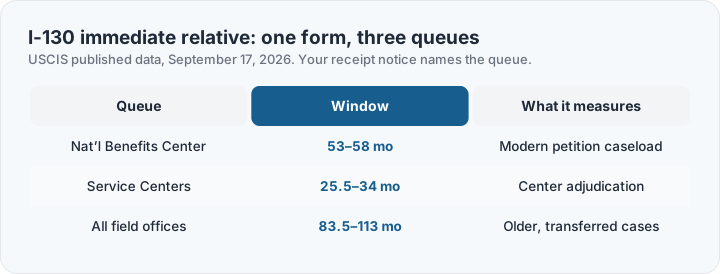
| Family category | National Benefits Center | Service Centers | All field offices |
|---|---|---|---|
| U.S. citizen for spouse, parent or child under 21 (immediate relative) | 53–58 mo | 25.5–34 mo | 83.5–113 mo |
| Permanent resident for spouse or child under 21 | 52–56.5 mo | up to 49.5 mo | 139–300.5 mo |
| U.S. citizen for unmarried son or daughter (21+) | 52.5–55.5 mo | up to 109.5 mo | 195–268 mo |
| Permanent resident for unmarried son or daughter (21+) | 53.5–56 mo | up to 76 mo | 188.5–340 mo |
| U.S. citizen for married son or daughter | 53.5–64.5 mo | up to 151 mo | 110.5–159 mo |
| U.S. citizen for brother or sister | 57–66.5 mo | up to 177 mo | 286.5–306.5 mo |
The official notes, translated
USCIS attaches two kinds of notes to I-130 rows, and both matter. The statutory note says the category is capped by law — family preference categories (F1, F2, F3, F4) have yearly visa limits, so the published range includes waiting for a visa to exist, not just USCIS's work. No premium processing, no expedite, no attorney fixes that half; the priority date guide explains the second, longer clock. The prioritization note says USCIS is deliberately moving certain petitions first — queue-jumping by design, which makes the remaining rows slower.
- Permanent resident for spouse or child under 21 (All Field Offices): This processing time reflects statutory constraints on available immigrant visas, for which the wait times are typically much longer than the time it takes for USCIS to adjudicate the form.USCIS service centers prioritize the processing of Form I-130 preference petitions for which an immigrant visa is available according to the Department of State Visa Bulletin. The visa bulletin, published monthly, lists available immigrant visas by priority date. We use the visa bulletin to determine the current visa categories and priority dates before processing Form I-130 preference petitions. We are prioritizing our adjudication efforts to focus on cases that have visas available.
- U.S. citizen for spouse, parent or child under 21 (immediate relative) (All Field Offices): USCIS service centers are now prioritizing the processing of Form I-130 preference petitions for which the Department of State Visa Bulletin shows that an immigrant visa is available. The visa bulletin, published monthly, lists available immigrant visas by priority date. USCIS uses the visa bulletin to determine the current visa categories and priority dates before processing a Form I-130 preference petition. Service centers have prioritized our adjudication efforts so that we can focus on those cases that have visas available.
- U.S. citizen for unmarried son or daughter (21+) (All Field Offices): This processing time reflects statutory constraints on available immigrant visas, for which the wait times are typically much longer than the time it takes for USCIS to adjudicate the form.USCIS service centers prioritize the processing of Form I-130 preference petitions for which an immigrant visa is available according to the Department of State Visa Bulletin. The visa bulletin, published monthly, lists available immigrant visas by priority date. We use the visa bulletin to determine the current visa categories and priority dates before processing Form I-130 preference petitions. We are prioritizing our adjudication efforts to focus on cases that have visas available.
- Permanent resident for unmarried son or daughter (21+) (All Field Offices): This processing time reflects statutory constraints on available immigrant visas, for which the wait times are typically much longer than the time it takes for USCIS to adjudicate the form.USCIS service centers prioritize the processing of Form I-130 preference petitions for which an immigrant visa is available according to the Department of State Visa Bulletin. The visa bulletin, published monthly, lists available immigrant visas by priority date. We use the visa bulletin to determine the current visa categories and priority dates before processing Form I-130 preference petitions. We are prioritizing our adjudication efforts to focus on cases that have visas available.
What happens after approval
An approved I-130 is a milestone, not a finish line. If the beneficiary lives abroad, the case travels to the National Visa Center for document processing and then to a consulate for the interview — stages that live outside USCIS's published ranges entirely. If they are in the U.S. and eligible, adjustment of status (I-485) may already be possible, and in immediate-relative cases it can be filed in the same envelope as the petition. The green card timeline assembles every leg with current numbers, and the I-485 page covers the field-office stage this petition feeds.