Adjustment of status (AOS)
Applying for a green card from inside the United States (Form I-485), instead of finishing the process at a consulate abroad. Adjustment cases are decided at USCIS field offices, which is why I-485 waits are published office by office.
Advance parole (AP)
Permission to re-enter the U.S. after foreign travel while your I-485 is pending (part of Form I-131). Leaving without it abandons the adjustment application. See the current published wait on the I-131 page.
Biometrics
Fingerprints, photo and signature USCIS uses for background checks. Some cases require an appointment; for many I-485 and N-400 cases USCIS reuses prints already on file and the status simply shows fingerprints taken.
Case inquiry
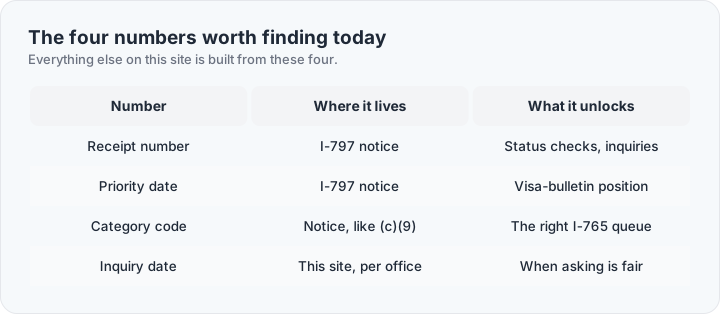
A formal "where is my case" request you can make once your receipt date is older than the inquiry date USCIS publishes for your form and office (the service request date in our tables).
Concurrent filing
Filing I-485 together with the underlying petition (for example I-130 or I-140) in one package when a visa is immediately available. It saves one full queue, which is why combined cases often finish faster than the two published ranges added together.
EAD category code
The letter-number code on a work permit (like (c)(9) for I-485 applicants). USCIS publishes a separate processing range per code on the I-765 page.
Expedite request
A free, case-by-case request to speed a case for urgent humanitarian or business reasons. Different from premium processing, which is a paid guarantee only for eligible form types.
Field office
A local USCIS office where interviews happen (I-485, N-400 and other in-person cases). There are dozens across the country and their published waits differ a lot — see the field office directory.
National Benefits Center (NBC)
The USCIS center that handles pre-processing work for family-based cases — most I-130 petitions appear there in today's published tables before cases move on toward consulates or field offices.
NOID (Notice of Intent to Deny)
A stronger version of an RFE: USCIS proposes to deny unless the response changes the picture. Response windows are short and the notice states them.
Priority date
Your place in line for a visa — usually the date USCIS received the petition (I-130, I-140 and similar). When demand exceeds yearly limits, cases wait for their priority date to become current. See the priority date guide.
Receipt number
The 13-character code (three letters + ten digits, like MSC2190012345) that identifies your case. Every status check and inquiry runs on it.
RFE (Request for Evidence)
USCIS's way of saying the file is not convincing enough yet. The notice lists exactly what to send and the deadline. Responding well and fast keeps the case moving.
Retrogression
When a visa category's priority date moves backwards in the monthly Visa Bulletin because the year's supply ran out. Waiting times can grow overnight for backlogged categories.
Service center
A large USCIS facility that adjudicates petitions by mail without interviews (I-130 and I-140 work, most I-765 and I-131). Today's published tables report service-center work under the Service Centers heading, plus named centers such as the National Benefits Center.
TPS (Temporary Protected Status)
Temporary status for nationals of designated countries facing conflict or disaster. TPS-related EAD categories have their own published ranges on the I-765 page.
Visa bulletin
The State Department's monthly chart that says which priority dates are "current" (eligible to apply). USCIS processing times and the visa bulletin answer different questions: how fast USCIS works vs. whether a visa is available yet. The official bulletin is at travel.state.gov.
80% window
How to read every number on this site: USCIS publishes the range in which roughly 80% of recently completed cases finished. Faster cases fall below it, slower cases above it — it is an envelope, not a promise.
Where to go from here
Terms are load-bearing on this site: the wait estimator runs on receipt dates and inquiry dates, the form pages publish 80% windows per queue, and the status decoder uses USCIS's own message names. If any page uses a word this glossary does not define, the contact page is open — clear language is a feature, not a favor.