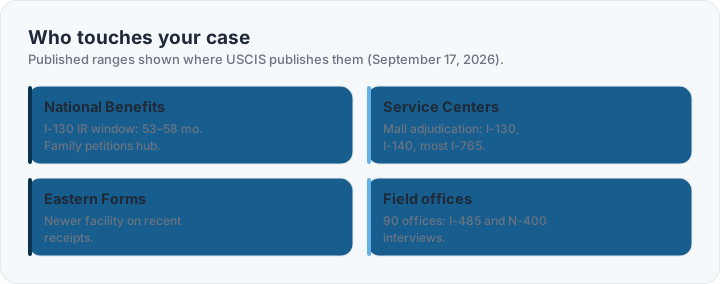
The four kinds of facility
Service centers are the mail-adjudication workhorses: petition forms reviewed on paper and screens, no interviews. In today's published processing tables their combined work is reported under a Service Centers heading rather than per legacy facility — so the I-140 range (3–6.5 mo for EB-2 advanced degree, for example) is one queue, not five. Notices and receipt-number prefixes may still name specific facilities like the Texas, Nebraska, Vermont or California centers that many applicants still search for by name; those names describe where a file sits, while the published ranges describe how fast that kind of work is moving.
The National Benefits Center (NBC) is the family-cases hub: most I-130 petitions appear there in the current tables, with the immediate-relative window at 53–58 mo. The Eastern Forms Center (EFC) is a newer forms facility appearing on recent receipts. And field offices — 90 of them — own every interview form: I-485 and N-400 cases are decided in person, which is why those waits publish office by office instead of as one national number.
What the queues say right now
| Category | Office / queue | Published 80% window | vs previous release | Inquire after |
|---|---|---|---|---|
| Permanent resident for spouse or child under 21 | National Benefits Center | 52–56.5 mo | +1 mo | February 08, 2022 |
| U.S. citizen for spouse, parent or child under 21 (immediate relative) | National Benefits Center | 53–58 mo | +1.5 mo | December 28, 2021 |
| Permanent resident for spouse or child under 21 | Service Centers | up to 49.5 mo | +1 mo | September 10, 2022 |
| U.S. citizen for spouse, parent or child under 21 (immediate relative) | Service Centers | 25.5–34 mo | +2.5 mo | December 23, 2023 |
| EB-1 · Extraordinary ability | Service Centers | 32.5–35.5 mo | +1 mo | November 07, 2023 |
| EB-1 · Outstanding professor or researcher | Service Centers | 15–18.5 mo | -0.5 mo | April 10, 2025 |
| EB-1 · Multinational executive or manager | Service Centers | 27.5–29.5 mo | +0.5 mo | May 02, 2024 |
| (c)(9) · Pending I-485 adjustment | National Benefits Center | 12–16.5 mo | +1.5 mo | June 11, 2025 |
| (c)(26) · H-4 spouse of H-1B | Service Centers | 17.5–19 mo | +0.5 mo | March 18, 2025 |
| (c)(9) · Pending I-485 adjustment | Service Centers | 12.5–16 mo | +0.5 mo | June 22, 2025 |
| Re-entry permit / refugee travel document | Service Centers | 16.5–21.5 mo | +0.5 mo | January 08, 2025 |
| Advance parole | Service Centers | 26.5–34 mo | +4.5 mo | December 25, 2023 |
Why this matters for reading any wait
The facility a case sits at changes which number applies to it — a pending-I-485 work permit shows a Service Centers row (12.5–16 mo for (c)(9)) while the underlying I-485 shows a field-office range, and both are correct for the same person in the same month. When a forum post says “my I-130 took X months,” the only useful follow-up is: at which queue? This site labels every range with its queue for exactly that reason, and the wait estimator keeps the queues straight for your case.