What a priority date is
Your priority date is, for almost everyone, simply the date USCIS received your underlying petition — the I-130, I-140 or similar. It is printed on the I-797 receipt and approval notices. Think of it as a ticket number issued the day you joined the line: it never changes, transfers between petitions in limited family cases, and everything about visa availability is measured against it.
The visa bulletin: the monthly scoreboard
Each month the State Department publishes the Visa Bulletin, which says which priority dates can proceed, per family and employment category and per country. A “C” means the category is current — anyone can proceed. A listed date means only cases with earlier priority dates may move. The official bulletin lives at travel.state.gov; it is a different agency, a different clock, and it can move backwards (retrogression) when a year's visa supply runs out.
How the two waits stack
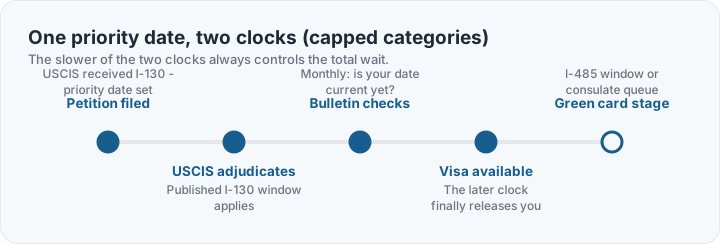
For immediately-available categories — spouses of U.S. citizens, parents, minor children — the visa side is always current, so USCIS processing time is the only wait: the published I-130 and I-485 windows are the whole story. For capped categories — the family preferences (F1–F4) and some employment lines — the waits stack: the petition must be adjudicated, and the priority date must become current, before a green card can finish. The later of the two clocks controls. USCIS even marks the affected rows in its own tables with a statutory limits note — you can see it on the I-130 page.
A concrete example
Say USCIS received your I-130 — a citizen petitioning for a married daughter, the F3 category — on March 10, 2024. Your priority date is March 10, 2024, permanently. The petition itself may be adjudicated inside the published I-130 range for its queue — but F3 is visa-capped, so the green card cannot finish until the bulletin announces that F3 dates earlier than March 10, 2024 are current for your country. If the bulletin currently shows a date years earlier, the bulletin queue is the long pole and USCIS’s processing speed is almost irrelevant to your total wait; if the category later shows “C,” the published windows on this site become the operative clock again. One date, two clocks, and the slower one always wins — that is the entire game.
Reading your own position
Three steps: find your priority date on the I-797; find your category and country's row in the current bulletin; compare. If your date is earlier than the listed date, the visa side is open and the published processing windows on this site are your timeline. If it is later, the bulletin queue is the longer pole, and no premium option touches it — the honest lever is time. The green card timeline shows where each wait sits in the journey, and the service centers page explains why petition ranges differ by queue.